

AI-generated court filings are becoming a major legal-industry issue in 2026. Lawyers now have access to tools that can summarize cases, draft motions, organize authorities, and produce first versions of briefs in minutes. However, faster drafting has also created a serious problem: artificial intelligence can invent cases, misstate holdings, create inaccurate quotations, or produce arguments that sound polished but do not match the governing law.
Courts are responding with stronger warnings, local rules, certification requirements, and sanctions when lawyers submit inaccurate AI-assisted work. The central principle is straightforward. A lawyer does not transfer responsibility to software simply because a tool helped prepare the document. The attorney who signs or submits a filing remains responsible for its accuracy, legal support, and compliance with court rules.
That principle matters for attorneys, firms, and clients. It also connects to broader questions about AI in law firms, professional ethics, litigation strategy, and legal technology. This article explains why courts are paying closer attention to AI-assisted filings and what responsible verification should look like.
Why AI-Generated Court Filings Are Under Greater Scrutiny
Generative AI can be useful at the beginning of legal research or drafting. It can help identify issues, organize facts, create outlines, suggest search terms, and summarize long documents. Yet those benefits do not make the output reliable by default. Large language models generate responses based on patterns in data. They can produce information that appears confident and complete even when a citation, quotation, factual statement, or legal conclusion is wrong.
In court, that weakness has higher stakes. A false citation in a filed brief can waste judicial time, force opposing counsel to investigate nonexistent authority, damage credibility, and expose a lawyer or firm to sanctions.
Courts Are Seeing More AI Errors in Legal Filings
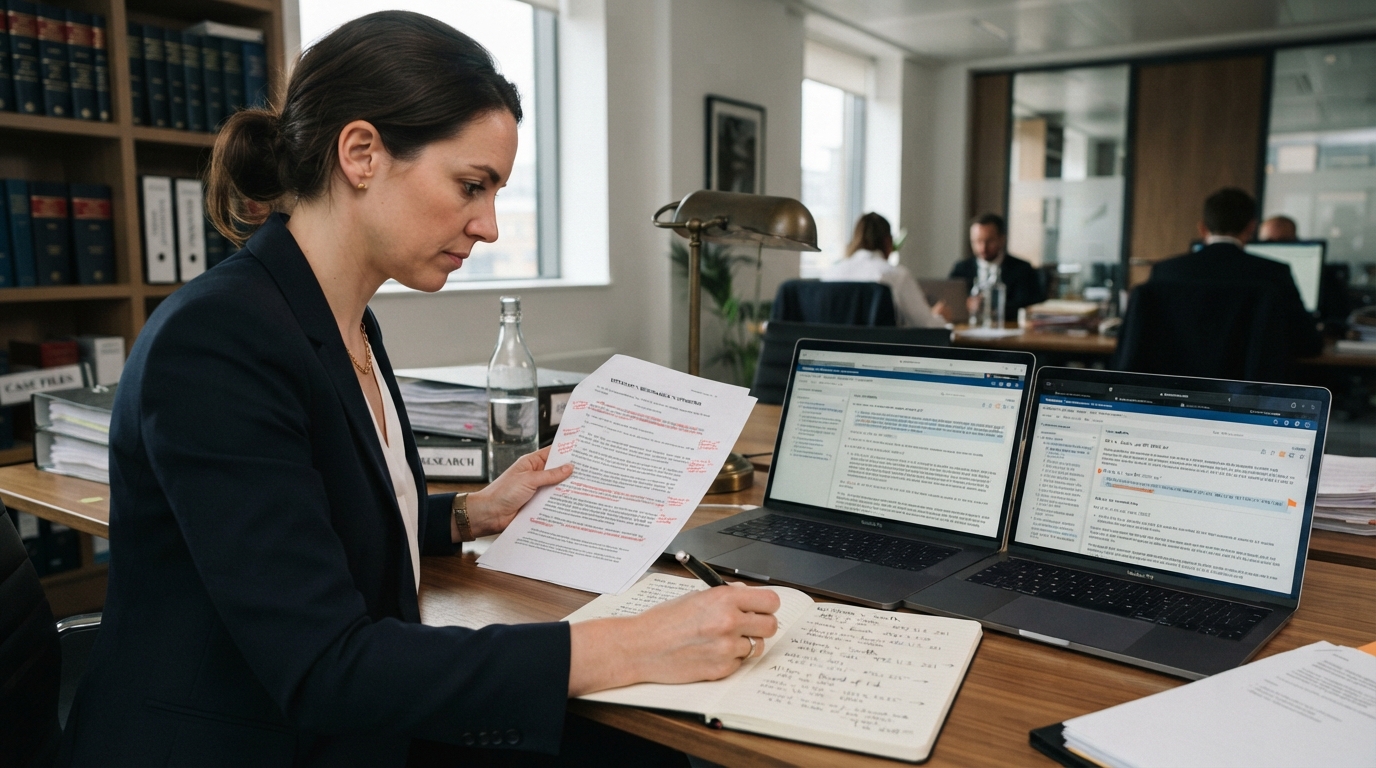
Recent court decisions and legal-industry reporting show that AI-related filing problems are no longer isolated. Lawyers have been sanctioned for submitting briefs containing fabricated authorities and inaccurate quotations. Courts have also warned about filings that may be technically free of fake citations but are disorganized, repetitive, or difficult to understand because the lawyer did not meaningfully review the generated material.
The risk is not limited to a fictional case. AI can cite a real decision for the wrong proposition, confuse procedural history, or present an outdated rule as current law. A lawyer therefore cannot verify a filing merely by checking whether the case name exists.
Hallucinated Cases Are Only the Most Obvious Failure
The term “hallucination” is often used when generative AI produces information that is false but presented as if it were real. In legal drafting, the clearest example is a nonexistent judicial opinion. However, subtler mistakes may be harder to detect.
A real opinion may be quoted inaccurately. A quotation may come from a dissent rather than the majority. A case may involve a different jurisdiction or procedural posture. A statute may have been amended. An AI system may also omit controlling authority that weakens the argument it was asked to develop.
For this reason, attorneys should return to the original authority. They should read the relevant portion of the case, confirm the court and date, verify subsequent treatment, and check whether the proposition actually supports the argument being made. Our Litigation & Legal Process section explains why procedure, jurisdiction, and the status of authority can materially affect legal analysis.
Bad Structure Can Be a Problem Even Without Fake Citations
Accuracy is essential, but courts also expect lawyers to present arguments in a clear and useful form. A generated brief may repeat the same idea several times, include irrelevant authorities, bury the key issue, or use language that sounds formal without advancing the client’s position.
A lawyer can verify every citation and still submit a poor filing if the document lacks professional editing. Court advocacy requires judgment about which facts matter, which authorities control, and which arguments actually help the court decide the issue.
AI can assist with that process, but it should not control it. A filing should sound like the work of a lawyer who understands the record, the law, and the requested relief—not like an unfiltered collection of generated paragraphs.
Rule 11 and the Duty of Candor Still Apply
Existing professional rules already place responsibility on lawyers who submit material to courts. Federal Rule of Civil Procedure 11 generally requires an attorney or unrepresented party presenting a filing to conduct an inquiry reasonable under the circumstances and to ensure that legal contentions are supported by existing law or a nonfrivolous argument for changing it. Factual contentions also must have appropriate evidentiary support.
Courts have increasingly emphasized that these duties do not disappear when artificial intelligence is used. The Eastern District of Texas, for example, expressly states in Local Rule CV-11(g) that litigants remain responsible for the accuracy and quality of legal documents produced with generative AI and must review and verify the content. Readers can review the court’s official rule through Eastern District of Texas Local Rule CV-11.
The American Bar Association takes a similar approach in Formal Opinion 512. The opinion applies existing professional duties to generative AI rather than creating an exception for it. It identifies obligations involving competence, confidentiality, communication, supervision, meritorious claims, candor to the tribunal, and reasonable fees.
Verification Must Go Beyond Asking Another AI Tool
Using one AI system to check another may feel like verification, but it does not establish that the underlying authority exists or supports the draft.
A stronger process uses primary and trusted legal sources. Lawyers should open the cited opinion, statute, rule, regulation, or record. They should compare quotations word for word, confirm pin cites, check whether the authority remains good law, and make sure factual assertions match evidence in the case.
Supervision matters as well. A partner who allows associates, paralegals, or staff to use generative AI should establish clear review standards. The same is true when a firm uses a vendor or specialized legal AI platform. Technology can change the workflow, but responsibility for the final filing remains human.
How Lawyers Can Use AI Without Giving Up Professional Control
The answer to AI-related filing problems is not necessarily to prohibit every use of generative AI. These tools can improve productivity when they are used for suitable tasks and paired with meaningful human review. The better approach is to separate assistance from authority.
AI may help brainstorm an outline, summarize a document that will later be checked, generate questions for further research, or produce a rough first draft. However, the lawyer should decide the legal theory, identify the controlling sources, verify the record, revise the reasoning, and approve the final language.
A Safer Verification Workflow for AI-Assisted Drafting

A practical workflow begins before the first prompt. Firms should define approved tools, what client information may be entered, and which tasks require heightened review. Sensitive material should not be entered unless confidentiality and security requirements are satisfied.
Next, the lawyer should treat generated output as a draft rather than a finished product. Every cited authority should be independently checked. Quotation should be compared with the original source. Every factual statement should be tied to the record. The lawyer should also search independently for controlling authority because an AI tool may omit cases that are unfavorable or more relevant.
After verification, the document still needs legal editing. The attorney should remove unnecessary material, confirm the requested relief, check court-specific rules, and make sure the argument reflects the client’s position.
Use AI as a Drafting Aid, Not as the Final Decision-Maker
The safest mental model is to treat generative AI as an assistant that can propose work, not as an authority that can approve it. A lawyer would not normally file a junior team member’s draft without reading it, checking key authorities, and confirming that it advances the correct argument. AI-assisted work deserves at least the same level of review, and often more.
Clients may also ask whether a firm has an AI policy, who reviews generated work, how citations are verified, and how confidential information is protected. Our Attorney Selection and Legal Trends, Ethics & Technology sections offer related guidance.
The legal profession is likely to keep experimenting with AI-assisted research and drafting. Courts, meanwhile, are making clear that innovation does not reduce the lawyer’s responsibility for what reaches the docket. That is the key lesson for 2026: AI may help prepare the work, but it does not sign the brief, make the certification, or answer to the court.
The advantage will not come from producing the most AI-generated text. It will come from using technology efficiently while maintaining accuracy, clarity, ethics, and independent judgment. Public confidence in legal technology ultimately depends on confidence in the professionals who use it.